5.3 FEEDING STIMULANTS AND DETERRENTS
Presumably, the beetle must not only determine that the bark
underneath is the proper host and is suitable for reproduction, but
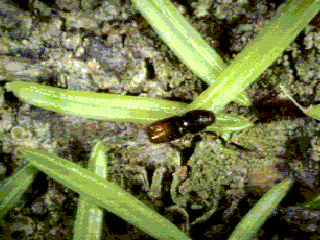 it must also judge potential competition by whether nearby areas
have bark beetles beginning their attacks. Many species of bark
beetle bore their entrance holes in a spaced or uniform pattern,
indicating the beetles are territorial in order to avoid
competition (Byers, 1984, 1992c). In some cases the beetle will
bore through the outer bark, regardless of the host, until it
encounters the phloem. For example, I. paraconfusus will bore
through the outer bark of the nonhost white fir, Abies concolor, as
readily as through bark of the host ponderosa pine. However, the
beetle only bores about 1 mm in white fir phloem and then leaves
(Elkinton and Wood, 1980). At this time gustatory stimulants and
deterrents (also possibly olfactory cues) are balanced in a
decision whether to continue feeding and excavating the gallery.
The beetle probably can determine whether the host tissue is of
good quality in terms of nutritional and moisture factors (Webb and
Franklin, 1978). The phloem of ponderosa pine, sugar pine (P.
lambertiana), Douglas-fir (Pseudotsuga menziesii), red fir (Abies
magnifica), and several other conifers contain about equal amounts
of glucose, fructose and sucrose (Smith and Zavarin, 1960). Bark
beetles have been induced to feed or lay eggs on several diets, but
the most successful contain some percentage of host (usually
phloem) tissue (Jones and Brindley, 1970; Richeson et al., 1970;
Whitney and Spanier, 1982; Conn et al., 1984; Byers and Wood,
1981b), indicating the presence of feeding or ovipositional
stimulants. Sucrose was found in preliminary experiments to
increase feeding by I. paraconfusus in powdered cellulose diets
(Byers and Wood, 1981b).
it must also judge potential competition by whether nearby areas
have bark beetles beginning their attacks. Many species of bark
beetle bore their entrance holes in a spaced or uniform pattern,
indicating the beetles are territorial in order to avoid
competition (Byers, 1984, 1992c). In some cases the beetle will
bore through the outer bark, regardless of the host, until it
encounters the phloem. For example, I. paraconfusus will bore
through the outer bark of the nonhost white fir, Abies concolor, as
readily as through bark of the host ponderosa pine. However, the
beetle only bores about 1 mm in white fir phloem and then leaves
(Elkinton and Wood, 1980). At this time gustatory stimulants and
deterrents (also possibly olfactory cues) are balanced in a
decision whether to continue feeding and excavating the gallery.
The beetle probably can determine whether the host tissue is of
good quality in terms of nutritional and moisture factors (Webb and
Franklin, 1978). The phloem of ponderosa pine, sugar pine (P.
lambertiana), Douglas-fir (Pseudotsuga menziesii), red fir (Abies
magnifica), and several other conifers contain about equal amounts
of glucose, fructose and sucrose (Smith and Zavarin, 1960). Bark
beetles have been induced to feed or lay eggs on several diets, but
the most successful contain some percentage of host (usually
phloem) tissue (Jones and Brindley, 1970; Richeson et al., 1970;
Whitney and Spanier, 1982; Conn et al., 1984; Byers and Wood,
1981b), indicating the presence of feeding or ovipositional
stimulants. Sucrose was found in preliminary experiments to
increase feeding by I. paraconfusus in powdered cellulose diets
(Byers and Wood, 1981b).
Few studies have attempted to isolate feeding stimulants in
conifer-feeding bark beetles, and none have isolated specific
compounds. Elkinton et al. (1981) extracted ponderosa pine phloem
successively with diethyl ether (partitioned with water), water and
then methanol, and added these extracts to powdered cellulose
diets. I. paraconfusus beetles were then given a choice between a
control diet and a diet with extract. The diet with the ether
extract did not cause beetles to remain longer, but did cause more
feeding but no preferential boring. The water partition of the
ether extract only caused beetles to remain longer. The water
extract elicited more boring and feeding, while the methanol
extract was inactive since feeding stimulants had already been
extracted by the ether and water treatments. These results indicate
that several compounds function in gustatory preferences. Solvent
(methanol-water-benzene) extracts of lodgepole pine bark (Pinus
contorta) were absorbed by tissue paper and shown to induce feeding
by D. ponderosae (Raffa and Berryman, 1982a). The benzene fraction
induced biting but not feeding while the polar fraction (water-
methanol) caused continued feeding. Differences in feeding
preferences for bark extracts were large between trees, but these
differences could not be attributed to amounts of 13 monoterpenes
as determined by gas chromatography (GC). Also, extracts of trees
judged resistant, because beetles that had been forced to attack in
cages either refused or discontinued attack, were as stimulatory to
feeding beetles as those from susceptible trees. In contrast, Hynum
and Berryman (1980) found greater feeding preferences for extracts
of bark of susceptible than of resistant lodgepole pine. However,
the susceptible trees had been killed by the beetles before solvent
extraction, which might have allowed microorganisms to produce
additional feeding stimulants. White (1981) also found differences
in gustatory deterrent and stimulatory properties of bark extracts
from different trees of loblolly pine, P. taeda.
In beetles of deciduous trees, most work on feeding stimulants
and deterrents involves the elm bark beetle, S. multistriatus.
Vanillin and syringaldehyde are short-range attractants inducing
feeding in S. multistriatus (Meyer and Norris, 1967b). Feeding
stimulants were isolated from the bark of American elm, Ulmus
americana, of which one was partially identified as a pentacyclic
triterpene (Baker and Norris, 1967). Later some lignin
intermediates and phenolics were indicated (Meyer and Norris,
1974). Doskotch et al. (1973) succeeded in identifying another
feeding stimulant in elm bark as a catechin xyloside. A tritiated
catechol feeding stimulant was shown to penetrate the gustatory
receptor of S. multistriatus (Borg and Norris, 1971). Scolytus
rugulosus are stimulated to feed in fruit trees by several phenolic
compounds (Chararas et al., 1982).
S. multistriatus was induced to feed on sucrose pith disks
when volatiles from benzene extracts of bark of nonhost trees
(Eastern cottonwood, Populus deltoides, and yellow buckeye,
Aesculus octandra) were placed 7 mm away (Baker and Norris, 1968).
However, these nonhost trees were not fed upon since they contained
nonvolatile feeding deterrents as shown by lowered feeding on a
mixture of host and nonhost extracts compared to host extracts. S.
multistriatus beetles do not attack the nonhost hickory, C. ovata,
due to the presence of juglone (5-hydroxy-1,4-napthoquinone), a
feeding deterrent (Gilbert et al., 1967). Elm tree tissue infected
by the fungus Phomopsis oblonga are avoided by S. multistriatus due
to several feeding deterrents of complex structure, e.g.,
oblongolide (isomer of dimethylnapthofuranone), a norsesquiterpene
lactone, two tiglic esters of 5,6-dihydro-5-hydroxy-2-pyrones,
nectriapyrone, 4-hydroxyphenylethanol, 5-methylmellein as well as
acids of 2-furoic, orsellinic, 3-nitropropanoic, and
mellein-5-carboxylic (Begley and Grove, 1985; Claydon et al.,
1985).
Diterpene acids (e.g., abietic, levopimaric, neoabietic and
palustric acids) have been isolated from ponderosa pine oleoresin
(Anderson et al., 1969; Himejima et al., 1992) and these are known
from other conifers to be antifeedants against aphids and sawflies
(Wagner et al., 1983; Schuh and Benjamin, 1984; Rose et al., 1981),
but have not been tested on bark beetles. Tannins, phenolics and
terpenoids that can inhibit feeding or digestion in other insects
(Berenbaum and Isman, 1989) could also affect bark beetles, but
again there are no reports. Ponderosa pine bark extracted first
with ether yields behenic and lignoceric acids, fatty alcohols,
resin acids, and flavonols (quercetin and myricetin, pinoquercetin,
pinomyricetin and dihydroquercetin), a subsequent acetone extract
contains tannins and phlobaphenes, while a hot-water extract has
tannin (6-11 % dry weight of bark) and carbohydrates (Anderson,
1962; Anderson et al., 1969). Many of these compounds are found
only in the outer bark and although they may be important in
deterring nonhost bark beetles, at least the host-adapted I.
paraconfusus does not eat the outer bark (Elkinton and Wood,
1980).

Byers, J.A. 1995. Host tree chemistry affecting colonization in bark
beetles, in R.T. Cardé and W.J. Bell (eds.). Chemical Ecology of
Insects 2. Chapman and Hall, New York, pp. 154-213.