1Department of Animal Ecology, Lund University, SE-223 62 Lund, Sweden
Present address:
2Chemical Ecology, Göteborg University, SE-405 30 Göteborg, Sweden
 pdf
pdf
 A storm-fallen Scotch pine, Pinus sylvestris, in the spring in southern Sweden. Resin exudes from
wounds on broken limbs and damaged bark and contains volatiles attractive to pine shoot beetles.
Deer may also eat the thinner bark and cause further wounding.
A storm-fallen Scotch pine, Pinus sylvestris, in the spring in southern Sweden. Resin exudes from
wounds on broken limbs and damaged bark and contains volatiles attractive to pine shoot beetles.
Deer may also eat the thinner bark and cause further wounding.
 Storm-fallen Scots pines with broken roots and trees with severed tops exude
wound oleoresin. These trees are susceptible to bark beetles due to an injured
vascular system that can not provide adequate oleoresin in order to resist new attacks by beetles [1). Once
a tree is attacked, most bark beetles use pheromone attractants to locate mates
and often to overcome tree resistance through a mass attack [1, 2]. It would
be clearly advantageous for bark beetles to have evolved sensory systems for
efficiently locating their host and in recognizing whether a particular host
was less resistant than most healthy trees. However, little is known of how
bark beetles select their host from among other plant and tree species [1],
or what may attract the first individuals to a susceptible host.
We have investigated
the semiochemical basis of the mass aggregation of pine shoot beetles,
Tomicus piniperda, on storm-injured Scots pine. We found that the
beetle can recognize while still in flight a host tree and whether it is susceptible
by means of olfaction of three plant monoterpenes evaporating from
wound oleoresin.
Storm-fallen Scots pines with broken roots and trees with severed tops exude
wound oleoresin. These trees are susceptible to bark beetles due to an injured
vascular system that can not provide adequate oleoresin in order to resist new attacks by beetles [1). Once
a tree is attacked, most bark beetles use pheromone attractants to locate mates
and often to overcome tree resistance through a mass attack [1, 2]. It would
be clearly advantageous for bark beetles to have evolved sensory systems for
efficiently locating their host and in recognizing whether a particular host
was less resistant than most healthy trees. However, little is known of how
bark beetles select their host from among other plant and tree species [1],
or what may attract the first individuals to a susceptible host.
We have investigated
the semiochemical basis of the mass aggregation of pine shoot beetles,
Tomicus piniperda, on storm-injured Scots pine. We found that the
beetle can recognize while still in flight a host tree and whether it is susceptible
by means of olfaction of three plant monoterpenes evaporating from
wound oleoresin.| Table 1. Attraction of flying Tomicus piniperda to traps releasing volatiles from Scots pine logs (28 cm x 13 cm diam.) or from glass tubes containing pine monoterpenes (each > 99 percent and released at about 30 mg/day at 18oC) in Scots pine plantations of southern Sweden | |||
| Catch on traps) | |||
|---|---|---|---|
| Trap contentsa | Male | Female | Totalb |
| March-April 1982 (22 replicates each treatment) | |||
| Blank control | 21 | 31 | 52c |
| Log | 309 | 314 | 623d |
| Log + 30 females | 325 | 315 | 640 |
| Log + 30 males | 319 | 313 | 632 |
| Log + 30 females + 30 males | 379 | 395 | 774 |
| April-May 1983 (17 replicates each treatment) | |||
| Blank control | 5 | 2 | 7e |
| A = (+)-3-Carene | 23 | 25 | 48 |
| B = (+)-alpha-Pinene | 29 | 31 | 60 |
| C = (-)-alpha-Pinene | 38 | 41 | 79 |
| D = Terpinolene | 57 | 47 | 104 |
| A + B | 24 | 29 | 53 |
| B + C | 54 | 53 | 107 |
| A + B + D | 107 | 96 | 203f |
| Log | 127 | 129 | 256 |
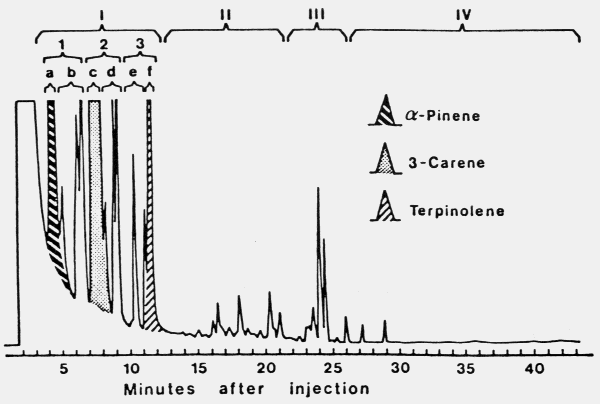
| Table 2. Attraction response of walking male and female Tomicus piniperda to monoterpenes occurring in Scots pine (28 April-8 May 1983). Monoterpenes were diluted in diethyl ether and released from 5 µl capillary tubes in a laminar air flow in a laboratory olfactometer [3] under dim red light at 8 lux | |||
| Percent responding - males/females | |||
|---|---|---|---|
| Amounts released ( x 2.2 g compound/min) | |||
| Test solution | 10-7 | 10-6 | 10-5 |
| (+)-3-Carene | 23/17 | 40a/47a | 50a/40a |
| (+)-alpha-Pinene | 20/23 | 33a/53a | 47a/47a |
| (-)-alpha-Pinene | 23/30a | 50a/37a | 50a/47a |
| Terpinolene | 27a/30a | 53a/57a | 53a/60a |
| Myrcene | 10/17 | 10/7 | 10/17 |
| Ether control | 10/13 | 3/7 | 10/10 |
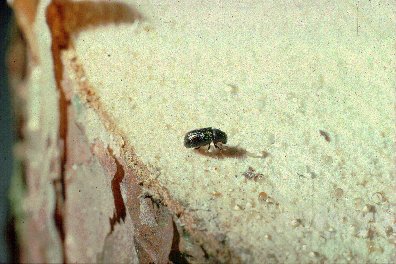
 T. piniperda pine shoot beetle and resin globules of Scotch pine oleoresin.
|
J. A. BYERS1, B. S. LANNE2, J. LÖFQVIST1, F. SCHLYTER1 and G. BERGSTRÖM2 1Department of Animal Ecology, Lund University, SE-223 62 Lund, Sweden Present address:
2Chemical Ecology, Göteborg University, SE-405 30 Göteborg, Sweden |
|---|