 ( 1 )
( 1 ) pdf
pdf Abstract--A puddle trap was designed that is simple to build and efficient in catching
bark beetles (Coleoptera: Scolytidae). The trap is insensitive to wind and should be much
easier to manufacture than the more complicated perforated pipe and barrier traps
commercially available. A 7 x 7 grid of 49 puddle traps baited with aggregation pheromone
components of Pityogenes chalcographus (chalcogran and methyl decadienoate) was
placed at either 1.5, 3, 6 or 12 m spacing between traps in the field for two or more replicates
of one day length (June 1989, Torsby, Sweden). The resulting catches showed that beetles
were trapped as they flew into the grid since the inner square-ring of 24 traps caught less
beetles per trap than the outer square-ring trap average (36 traps) in most experiments. Ips
typographus also landed in puddle traps primarily on the periphery of the grid (6 m spacing
only) when traps were baited with its pheromone components, (S)-cis-verbenol
and methyl butenol. Computer simulation of flying bark beetles in grids of traps of various
spacings and catch radii estimated that the experimental pheromone traps had an effective
catch radius of 1.3 m or less for P. chalcographus, depending on the spacing between
traps. An effective catch radius of 2 m for I. typographus was found for the 6 m grid
spacing. P. chalcographus beetles were increasingly disrupted in their orientation to
pheromone at the closer trap spacings since the effective catch radius declined linearly with
closer trap spacing. However, landing was still precise since unbaited puddle traps within the
grid did not catch any bark beetles.
Abstract--A puddle trap was designed that is simple to build and efficient in catching
bark beetles (Coleoptera: Scolytidae). The trap is insensitive to wind and should be much
easier to manufacture than the more complicated perforated pipe and barrier traps
commercially available. A 7 x 7 grid of 49 puddle traps baited with aggregation pheromone
components of Pityogenes chalcographus (chalcogran and methyl decadienoate) was
placed at either 1.5, 3, 6 or 12 m spacing between traps in the field for two or more replicates
of one day length (June 1989, Torsby, Sweden). The resulting catches showed that beetles
were trapped as they flew into the grid since the inner square-ring of 24 traps caught less
beetles per trap than the outer square-ring trap average (36 traps) in most experiments. Ips
typographus also landed in puddle traps primarily on the periphery of the grid (6 m spacing
only) when traps were baited with its pheromone components, (S)-cis-verbenol
and methyl butenol. Computer simulation of flying bark beetles in grids of traps of various
spacings and catch radii estimated that the experimental pheromone traps had an effective
catch radius of 1.3 m or less for P. chalcographus, depending on the spacing between
traps. An effective catch radius of 2 m for I. typographus was found for the 6 m grid
spacing. P. chalcographus beetles were increasingly disrupted in their orientation to
pheromone at the closer trap spacings since the effective catch radius declined linearly with
closer trap spacing. However, landing was still precise since unbaited puddle traps within the
grid did not catch any bark beetles. 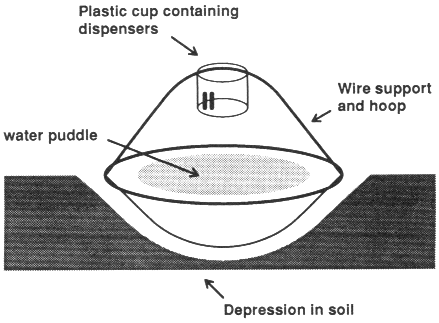
| mls = fws * (gsem/fwsem - fsem * gsem/fwsem)/fsem/gs | ( 1 ) |
|---|
| fsem = 1/(fwsem * mls * gs/(fws * gsem) + 1) | ( 2 ) |
|---|


| Table 1. Average catches and catch ratios of Pityogenes chalcographus and Ips typographus (per trap) for traps in various rings (see Figure 7) of a 7 x 7 trap grid (various spacings and dates, 1989). The ratio of the outer ring (n = 24) catch average divided by the inner ring (n = 16) catch average was used in the reciprocal quadratic equation (4), as determined by simulations, to find the effective catch radius. | |||||
| Average trap catch | |||||
|---|---|---|---|---|---|
| P. chalcographus | Outer ring | Inner ring | Center ring | Outer/inner catch ratio | Effective catch radius (m) |
| 12-m spacing | |||||
| Figure 3A, June 10 | 3.7 | 2.3 | 0.9 | 1.65 | 0.81 |
| Figure 3B, June 11 | 28.8 | 18.5 | 15.9 | 1.56 | 0.73 |
| Figure 3C, June 12 | 118.5 | 77.5 | 80.4 | 1.53 | 0.71 |
| 6-m spacing | |||||
| Figure 2A, June 7 | 108.4 | 62.7 | 54.8 | 1.73 | 0.87 |
| Figure 2B, June 10 | 55.5 | 40.8 | 42.9 | 1.36 | 0.54 |
| Figure 2C, June 11 | 246.0 | 248.8 | 236.8 | 0.99 | 0.01 |
| 3-m spacing | |||||
| Figure 4A, June 13 | 28.7 | 23.5 | 16.4 | 1.22 | 0.37 |
| Figure 4B, June 14 | 5.5 | 3.7 | 3.9 | 1.48 | 0.66 |
| 1.5-m spacing | |||||
| Figure 5A, June 15 | 4.9 | 5.8 | 3.3 | 0.86 | 0.00 |
| Figure 5B, June 16 | 14.9 | 13.0 | 8.5 | 1.14 | 0.26 |
| Figure 5C, June 16 | 7.0 | 7.0 | 5.0 | 0.99 | 0.02 |
| Ips typographus | |||||
| 6-m spacing | |||||
| Figure 6A, June 13 | 2.9 | 0.3 | 0.4 | 9.20 | 2.24 |
| Figure 6B, June 14 | 2.3 | 0.1 | 0 | 18.67 | 2.48 |
| Figure 6C, June 15 | 1.5 | 0.3 | 0.5 | 4.93 | 1.90 |
| Figure 6D, June 16 | 1.8 | 0.6 | 0.2 | 3.11 | 1.53 |

|
JOHN A. BYERS Department of Animal Ecology, Lund University, SE-223 62 Lund, Sweden Present address: 
|
|---|