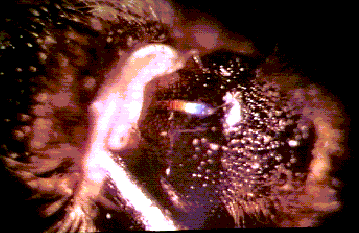
 Female Ips paraconfusus (Coleoptera: Scolytidae) head showing the "pars stridens" area that is stroked by the "plectrum" on the under
side of the dorsal anterior edge of the prothorax to produce chirping sounds called stridulation.
the "comb" or pars stridens (in latin) is made up of may fine rows of lines (or teeth) like on a phonograph record. If the light strikes the pars stridens from the
correct angle the whole area diffracts light into a spectrum of rainbow colors as seen here.
This beetle is a pest of ponderosa pine in California. For more information on this beetle press one or more below:
Female Ips paraconfusus (Coleoptera: Scolytidae) head showing the "pars stridens" area that is stroked by the "plectrum" on the under
side of the dorsal anterior edge of the prothorax to produce chirping sounds called stridulation.
the "comb" or pars stridens (in latin) is made up of may fine rows of lines (or teeth) like on a phonograph record. If the light strikes the pars stridens from the
correct angle the whole area diffracts light into a spectrum of rainbow colors as seen here.
This beetle is a pest of ponderosa pine in California. For more information on this beetle press one or more below:
Pheromone biosynthesis during feeding or exposure to vapours of host plant
precursors. 
Effect of mating on terminating aggregation during host colonization
Antibiotic-induced inhibition of pheromone synthesis
Influence of sex, maturity and host substances on pheromones in the guts
Sex-specific responses to aggregation pheromone: Regulation of colonization density
Pheromone production in a bark beetle independent of myrcene precursor in host pine species
Images © 1996 by John A. Byers, Chemical Ecology.